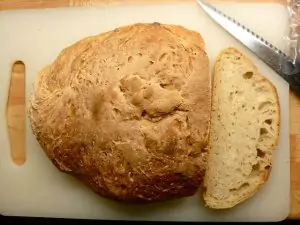
There’s nothing quite like the taste of sourdough bread. Depending on how you make it, you can get anything from a mild sweetness to a zingy tang that makes for a perfect compliment to several sweet and savory choices – jams, cheese, butter, and olive oil – all working together in perfect tandem.
Sourdough isn’t something you can normally whip up quickly, but you can save time with a good bread maker. With features like adjustable rise time and dough cycle options, even white bread and French bread you can find the best bread machine that suits your sourdough bread recipe.
While you can make it in just about any bread maker (provided you ferment the dough), some options out there have ‘ferment’ and ‘sourdough’ specific settings, which will allow you to make traditional and ‘quick’ sourdoughs on demand.
Ready for the smell of freshly baked sourdough in your home? The best bread maker for sourdough is waiting, so let’s get this party started and we’ll help you to find it!
Our Top 3 picks at a glance
Before we get the ball rolling, we understand that some of our readers are getting ready to run errands, go to work, or otherwise vacate the premises and don’t have time to dig into all of these bread maker reviews right away. Don’t worry – we’ve got you covered with this quick sneak peek at our favorites.
At the end of the article we’ll elaborate on each of these so that you can learn more, but for now, here’s your sneak peek at our 3 favorites and what we liked about them!
- Best Overall Bread Maker – Zojirushi Home Bakery Virtuoso Plus Bread maker – For those who value ease of use, modern bread makers come equipped with additional features like a 13-hour delay timer and LCD screens, making it easier than ever to press start and come back to a perfectly risen sourdough. Brands like Zojirushi are noted for their minimal effort required, appealing to home bakers seeking high-quality loaves. This was DEFINITELY our favorite.
- Best Bread Maker on a Budget – KITCHENARM 29-in-1 SMART Bread Machine with Gluten-Free Setting – 2 lb capacity – A bread maker doesn’t have to be expensive to be your favorite kitchen appliance and the Kitchenarm 29-in-1 proves it. This lightweight, low-unit gives you 29 presets, 7 of which are non-bread settings, and one ‘home made’ setting that is completely customizable. Add in that it has a 15-hour delay timer, as well as a 15-minute power interruption recovery and 1-hour keep warm timer and you’ve got one of the most feature-packed budget models around!
- Best Bread Maker for a Large Family – Breville Custom Loaf Bread Maker 2.5lb capacity – The Breville Custom Loaf Bread Maker is a brushed-steel beauty that can deliver 4 sizes of loaves (with 2.5-pounds being the largest) along with 13 presets and 3 crust settings. It bakes delicious bread and at 16.85 pounds, it’s robustly built to last!
What’s all the fuss about sourdough?
Sourdough bread really is some amazing stuff and a lot of work goes into making it that way. You see, unlike most of your standard breads, sourdough needs to be fermented first. The flavor that you get in the end will be determined by how long you ferment the dough.
For instance, with very little fermentation time, you can get a sourdough that has a little sweetness to it, or you can ferment for longer and get that tangy deliciousness that is the signature flavor of most sourdoughs on the market.
That vinegary tang that you get in the bread is a by-product of acetic acid, but you also get a flavor much like yogurt, that comes from lactic acid. These flavors come from a necessary step of making sourdough bread – the sourdough ‘starter’.
While there are different options you can choose for your sourdough starter, what it basically amounts to is a living, active culture of wild yeast, along with a lactic acid bacterial culture which is added to your flour and water and allowed to ferment for the time recommended in your recipe.
This can take days – so it’s easy to see why you might want a shortcut in the process to get your delicious sourdough bread fast.
Can you really make sourdough bread with a bread maker?
Yes, you can, but we need to set some expectations here. Advanced models even allow you to tweak the bake time and crust color, ensuring your sourdough or even sweet bread turns out exactly how you like it.
As fermentation is involved, you’re still going to have to deal with the ‘starter’ phase of making your sourdough, but bread machines can definitely help to reduce the work.
For instance, some bread machines have ‘ferment’ settings, and this can certainly help the process along by automating a part of your process. There are also recipes for ‘quick’ sourdoughs that will work in any bread maker if you don’t want to go through the process of fermenting your dough first.
The good news is that some of these ‘quick sourdoughs’ are pretty fantastic and really, how you make it will be up to you!
You can ferment your dough and bake the sourdough loaf in your trusty bread maker to produce a traditional sourdough, or you can use a recipe designed for your bread maker’s ‘sourdough’ setting and get the flavor that you are craving with a quickness.
If you’re ready, then let’s take a look at some of the best options on the market today for baking sourdough and your other favorite breads!
The Best Bread Maker for Sourdough
When choosing the perfect machine, consider the variety of different programs available, such as those for pizza dough, pasta doughs, and more specialized options like king arthur’s recommended bread machine sourdough recipe. The best breadmaker not only offers versatility but also high-quality loaves with a nice texture and soft crumb, achievable through proper gluten formation.
Now, it’s time to take a look at the best bread makers for sourdough, so in this section, we’ve compiled a list of 10 of them for you to see and evaluate against your needs and expectations. For each model, we’ll tell you the measurements and weight, as well as the features that each one brings to the table.
We’ll also tell you what we liked and didn’t like and later in the article, we’ll share our 3 favorites and you can see if you agree! The good news is, there’s not a bad bread maker on this list – they’re all winners – so if you don’t like our top 3, then just go with your gut!
You really can’t go wrong with any of these gems. With that said, let’s take a look at the best bread makers for sourdough and you can see what you think!
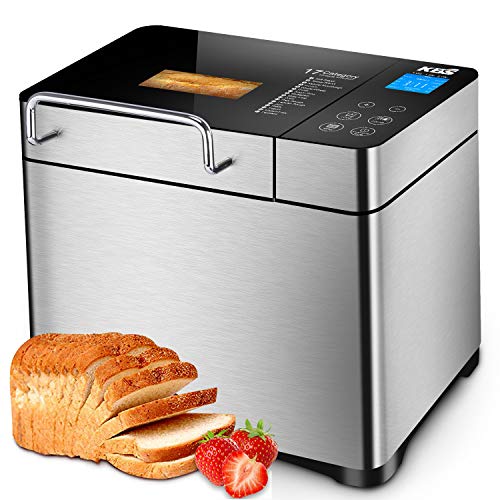
The KBS Pro 17-in-1 Stainless Steel Bread Machine is a beautiful appliance with a whole lot of extra functionality thrown in to sweeten the pot. Measuring 15.7″D x 11″W x 16.1″H and weighing a solid 14.7 pounds, it’s a good-looking machine, but what does it bring to the table?
Well, with the KBS Pro you’ve got 17 pre-programmed settings, as well as the option to create your own DIY settings so that you can bake 1, 1.5, or 2 lb loaves with relative ease.
Along with this, you get handy features like an automatic fruit and nut dispenser and a handful of useful accessories: 2 paddles, 1 hook, 1 oven mitt, 1 measuring cup and spoon, and more!
They even throw in a 2-year warranty, so if you want a shiny stainless-steel bread maker that definitely delivers, this KBS has got you covered!
Pros:
We like the scratch-resistant stainless steel- it makes the unit feel both solid and modern and really looks good in the kitchen. The DIY options and the fruit and nut dispenser are also pretty cool, and we like the included ceramic pot – all in all, it’s a really nice bread maker that you won’t mind having in the kitchen.
Cons:
There’s a little bit of a learning curve to get used to 17 functions and you’ll need to be careful not to chip the ceramic pans – hardly a dealbreaker, but we felt it should be mentioned.
2. Elite Gourmet EBM8103B Programmable Bread Maker Machine – 2 lb capacity

Next up is the Elite Gourmet EBM8103B which brings 19 functions to the table in a sleek, black (or mint) colored bread maker that you won’t mind having on the counter.
Measuring in at 9.45″D x 11.89″W x 13.98″H, this unit weighs a mere 9.98 pounds due to its lightweight aluminum construction, and you can use it to make 1-, 1.5-, and 2-pound loaves.
Aside from those 19 presets, you also get nice features like a 15-hour delay timer (wake up to the smell of bread baking!!) and a 60-minute keep-warm timer for a little extra control. Finally, you get a modest amount of accessories: 1 bread pan, 1 measuring cup and spoon, a lifting hook, and 1 kneading blade.
The Elite does all the kneading, rising, and baking for you, and you get to sit back and enjoy delicious, fresh bread – not a bad deal at all from a brand we all know and trust!
Pros:
After over 40 years of providing quality appliances, Elite Gourmet has done it again with the EBM103B. You get great bread at a consistently high quality with very little effort at all. The lightweight design is also quite nice and it doesn’t take up a lot of space.
Cons:
While all those presets have you covered, we would have liked some DIY functionality, but otherwise, it’s really hard not to like this bread maker. It does what it’s supposed to – make yummy bread – and that’s a pretty fantastic thing.
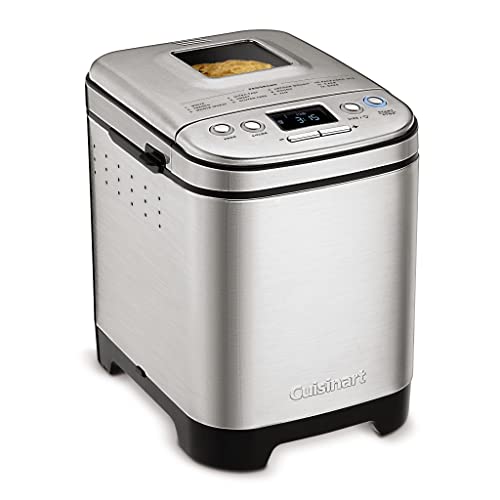
Speaking of names we know and trust, Cuisinart makes our list with their own Compact Automatic Bread Maker Machine and it’s a stainless-steel wonder for making up to 2-pound loaves. Measuring 10.25″D x 11.25″W x 13.25″H and weighing a mere 10,8 pounds, it’s certainly compact, but what do you get?
This unit features a modest 12 pre-programmed options, along with a setting that determines the crust shade – light, medium, or dark. It also has a 13-hour delay you can make good use of and uses alarm bells to assist you during the process so that you know when to do things like take out the paddle.
It also has a 60-minute ‘keep warm’ setting, as well as a nifty viewing window and interior light to show your bread as it’s baking. Add in that they throw in a 3-year warranty and you’ve got a recipe for a bread machine you’re definitely going to love!
Pros:
We like the compact design and the crust-shade feature is definitely cool – everyone has their favorite crust, after all, and you can have it with this bread maker. The view window and interior light are also a nice touch so that you can monitor the process as closely (or as relaxed) as you like.
Cons:
We would have liked a little more in the way of DIY options and having less pre-programmed settings will be great for some folks, but not-so-great for others – it’s your call.
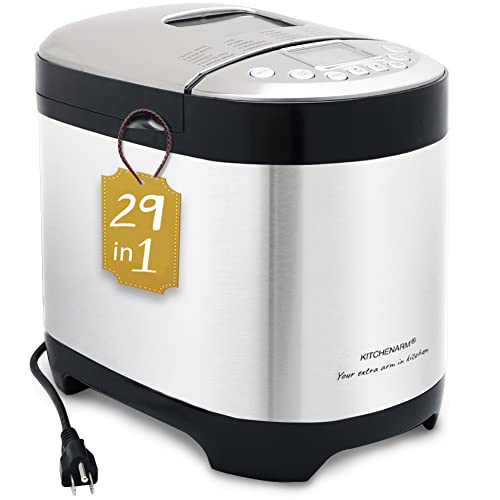
The Kitchenarm 29-in-1 Smart Bread Machine includes a gluten-free configuration among its very generous amount of pre-programmable settings. Measuring in at 10.2″D x 14.2″W x 12″H, this stainless-steel bread maker weighs 11.6 pounds and only uses 550 watts of power making up to 2 lb loaves!
Kitchen-certified, those 29 settings include 21 bread settings, as well as 7 non-bread options – such as yogurt, cake, pasta, and a ‘home made’ option that you can set for custom control. You can also set 3 crust colors, it has a 15-hour delay, 15 minute power-loss recovery, a 1-hour keep warm, and more.
Basically, it’s option packed, with a view window, and includes accessories like a hook, 2 paddles, 7 2-cup spoon sets, a recipe book, and more. If you love lots of functions to play with for making amazing loaves of bread, then consider the Kitchenarm – you’ll be happy that you did!
Pros:
This bread maker brings quite a lot to the table and we’d have to say that we LOVED it. The ‘home made’ function is easy to use and for folks who are very particular about their breadmaking, it’s a real godsend. It also doesn’t hurt that it’s lightweight and no-nonsense stainless-steel construction.
Cons:
You need to be careful removing the pan when it’s done as it gets pretty hot, but that’s really the only thing we didn’t like (and that’s pretty easy to avoid with mitts!).
5. Neretva Bread Maker Machine, 20-in-1 2 lb Automatic Breadmaker with Gluten Free setting

Our next bread maker is this Neretva which is available in green, mint green, or silver, and brings 20 bread-making functions to the table. Measuring 11″D x 7.9″W x 9.25″H, this unit only weighs 8.35 pounds and uses a low 565 watts to work its magic.
Included in the 20 functions, you can make some non-bread items such as yogurt or jam, it has a gluten-free setting, and it has a host of other useful features 360-degree cooking, a 1-hour warm timer, 15-hour cooking delay, and a large viewing window to help ensure that everything is going perfectly.
Included accessories are 1 measuring spoon, 1 measuring cup, a paddle removal tool, 1 kneading tool, and kitchen gloves. All and all, it’s a nifty little bread making machine that you’re going to love having in the kitchen!
Pros:
Colorful and with 20 different functions, it’s versatile enough without going overboard, and quite light compared to other models.
Cons:
This model features a dial control, which you may or may not like – so the only caveat boils down to your personal preference.

If you love freshly baked bread and don’t mind investing in an upgrade, then this Zojirushi Home Bakery Virtuoso might be just what the doctor orders. Measuring in at 10.5″D x 18″W x 12.88″H, this unit weighs 24 pounds, but that’s because it has some very useful tech built into it.
The Virtuoso features dual heaters for perfect, even heating, as well as double kneading, and a programmable LED display. Presets are present for whole wheat, multigrain, sourdough, and more, and you can also customize courses as you like.
A large view window lets you watch the progress and it includes other features like a 13-hour timer, recessed handles for easy transport, and express settings that will let you whip up a whole wheat or white loaf in just 2 hours and 25 minutes!
Included accessories are nesting measuring cups, 1 liquid measuring cup, and a measuring spoon – all you need but the gloves and ingredients, when you get right down to it!
Pros:
Its dual heating elements and mixing paddles ensure even cooking and proper gluten formation, essential for true sourdough and king arthur flour recipes. The instruction manual and test kitchen approval highlight its ease of use, making it a top-notch bread machine for both various bread machines and sourdough enthusiasts.
Cons:
This is not as cost-effective as some of the other options and some folks may not be pleased about the weight. That said, if you are a serious bread lover or a sandwich connoisseur, the output you’ll get is worth every penny.
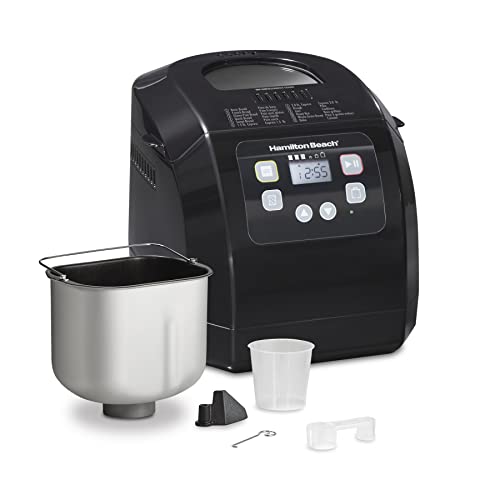
The Hamilton Beach Bread Maker is a budget option that can deliver delicious bread with the best of them. Measuring 13.9″D x 11.4″W x 11.2″H and weighing 10.83 pounds, this unit can produce up to a 2-pound bread loaf with appreciable ease.
The Hamilton Beach features 12 presets, including options such as sweet, jam, and roast nuts, and the bread bucket and accessories are all dishwasher safe. During cooking, your time is displayed on a digital timer, and you can select a light, medium, or dark crust to your preference.
Finally, it features a keep warm option and a nonstick bread pan and comes with the following accessories: 1 kneading paddle, 1 paddle removal tool, 1 measuring cup, and 1 measuring spoon. It’s not fancy, but it definitely gets the job done right!
Pros:
Its different settings for crust color and range of loaf sizes cater to all dietary needs, making it a good choice for home bakers. With minimal effort, users can explore a bread-making process involving live sourdough starter and instant yeast, producing better bread than what’s available in a grocery store.
If you are looking for a bread maker on a budget, the Hamilton Beach is a great option with a few nice features that won’t break the bank.
Cons:
If you’re looking for extras like a 15-hour timer delay and additional presets (or customized settings), then another model is going to be a better fit.
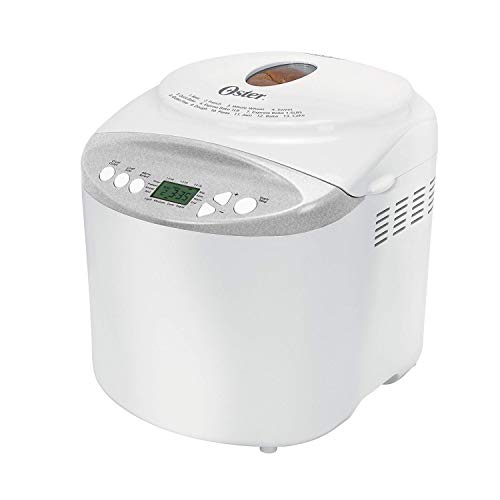
This budget bread maker is the Oster Expressbake and it’s good for baking up to a 2lb loaf without a lot of hassle. Measuring 12.1″D x 13.5″W x 13.2″H and weighing only 8 pounds, it’s a lightweight model that brings some excellent features to the table.
The Oster Expressbake can whip up a fresh loaf in 1 hour, but you also have 13 presets that you can use for different breads and it will also do jams and gluten-free breads.
This unit also has a 13-hour timer, a small viewing window to check progress, and you can select the crust you like on your bread – light, medium, or dark. Overall, it’s a budget option that doesn’t skimp on the features, which can make you delicious bread on demand with a quickness!
Pros:
The 1-hour bake is pretty stellar for when you get that sudden craving for fresh-baked bread and it has enough presets to keep things interesting, without overloading you with options.
Cons:
The unit is plastic, rather than stainless steel, and the viewing window is a little bit on the small side. If that’s not a dealbreaker, however, it’s still a really nice bread maker that can deliver 2-pound loaves with the best of them.

This handsome brushed stainless-steel bread maker comes from Breville and it’s capable of producing an enormous 2.5-pound loaf on command! Measuring in at 9.6″D x 16.4″W x 13.3″H and weighing a solid 16.85 Pounds, it’s definitely built to last, but what do you get with this beast?
With 13 presets, 3 crust settings, and 4 loaf sizes you can choose – 1, 1.5, 2, and 2.5 lbs – you’re good to go for many different types of bread, including gluten-free bread, pasta, jams, and more.
This unit also features a fruit and nut dispenser that will release your ingredients during the kneading cycle for perfect, delicious distribution. Included with your Breville Custom Loaf Bread Maker is a 46-recipe book that includes sourdough and other favorites and walks you through each step-by-step.
While it lacks an LCD screen and control panel found in automatic bread makers like the Zojirushi bread maker, its ability to produce high-quality loaves with various settings remains unmatched for home bakers seeking to make their own bread.
If you’re looking for a bread maker that can deliver quality and volume, then the Breville might just be your new favorite kitchen tool!
Pros:
It looks great in the kitchen, delivers high-quality large loaves, and it’s easy to use. This is a great option for larger families who have a constant craving for delicious, fresh-baked bread.
Cons:
It’s not the most cost-effective option, so it won’t be a fit for every budget, but if you don’t mind spending a little extra it sure is nice being able to bake 2.5-pound loaves on command!
FAQs
It’s just about time to render our verdict on the best bread maker for sourdough but before we do, we wanted to address a few frequently asked questions that we get all of the time from our readers. Let’s take a peek and then we’ll get to our official wrap-up!
Can sourdough starter be used in bread makers?
Yes, sourdough starter can be used in a bread maker instead of yeast, all you need to do is add the starter first, followed by your flour, your sugar (or honey), the butter, and the salt. After that, just select your ‘sourdough’ preset or equivalent setting and let the bread maker work its magic!
Can you use a bread maker to knead sourdough?
Yes, bread makers can definitely knead the dough for you and save you a whole lot of time. Not only are they efficient, but some models even have two kneaders inside that can make short and perfect work of whipping up your dough.
If you’re new to bread making or simply want to save some time, then take advantage of modern technology and let your bread maker do the work – that’s what it’s designed for and you’re going to love the results!
What is the best flour for a bread maker sourdough starter?
You can use any flour that you would normally use in your sourdough and your bread maker will be up to the task. That said, if you’d like a recommendation, then go with 50% all-purpose or bread flour and 50% wholemeal wheat or rye.
You’ll get delicious results and all of your ingredients are easy to find, so this combination is just about perfect for baking up a yummy sourdough at home.
Can I make different types of bread, like french bread or sweet bread, with these machines?
Absolutely! The best bread machines offer different programs for a range of bread, including french bread, white bread, pizza dough, and sweet bread, ensuring you can meet all your dietary needs with minimal effort.
The Verdict
So, we’ve gone through 10 of the best bread makers on the market and now it’s time for us to share our favorites and what we liked about them.
Just keep in mind that these were OUR favorites – all of the bread makers that we have shared today are excellent options – so if another model fits your needs better then proceed with confidence. You really can’t go wrong with today’s list!
With that out of the way, here are our 3 bread makers from the list we reviewed today!
Best Overall Bread Maker – Zojirushi BB-PDC20BA Home Bakery Virtuoso Plus Bread maker
Weighing in at 24 pounds and clothed in Stainless steel and black, the Zojirushi BB-PDC20BA Home Bakery Virtuoso means business and that business is bread! Capable of baking a loaf of standard white or wheat bread in just 2 and a half hours, owning this machine means you can have fresh bread every day – multiple times if you like!
There are excellent sourdough recipes that are specifically tailored for this amazing device and it comes with a host of useful features. For instance, you have course settings for vegan, gluten-free, multigrain, whole wheat, salt or sugar-free, and rapid whole wheat.
Dual heaters and dual kneaders are the biggest part of what adds weight to this device and helps to produce such excellent finished loaves, and you have your choice of light, medium, or dark crust so that your finished bread is perfectly tailored to your taste.
If you love having on-demand fresh bread, this Is the fastest and most efficient model in its price range and well worth the investment!
Best Bread Maker on a Budget – KITCHENARM 29-in-1 SMART Bread Machine with Gluten-Free Setting – 2 lb capacity
The Kitchenarm 29-in-1 SMART Bread Machine is a budget option that has more features than you can shake a stick at. With 29 presets – 7 of which are non-bread items like ham and yogurt – you’ve got a lot of versatility from the get-go, but the ‘home made’ setting is even better.
With ‘home made’, you can easily configure custom settings for your favorite bread recipes, so that you don’t have to rely on some preset that doesn’t know baking as well as YOU do.
With a 15-hour delay timer, 15-minute power recovery, 1-hour keep-warm setting, and 3-crust settings, you’ve got the major perks from more expensive competitors, with extras thrown in like alarms that tell you when to add fruit and nuts.
It doesn’t feel like a budget model at all, really, and it doesn’t even look like one either with its robust stainless-steel build. If you’re on a budget, this will give you the delicious fresh bread you are craving and enough variety in the options to see you through for years. What more could you ask?!
Hands down, this was the Best Bread Maker on a Budget!
Best Bread Maker for a Large Family – Breville Custom Loaf Bread Maker 2.5lb capacity
Our final entry wins the title of Best Bread Maker for a Large Family. The Breville Custom Loaf Bread Maker can make loaves of 1, 1.5, 2, or 2.5-pound size, and features nice extras like a fruit and nut dispenser that delivers at exactly the right time, as well as 13 baking presets, and 3 crust settings.
It also uses a unique and proprietary collapsible kneading paddle that helps to ensure all of your ingredients are well and thoroughly mixed, collapsing as soon as the bake cycle begins to minimize any marring of the loaf that you might get from lesser bread makers.
This unit also supports custom settings and comes with a 46-page recipe book that tells you step-by-step how to whip up a large list of delicious, fresh breads.
If you are from a family of bread-lovers, then the Breville can ensure that you’ll be enjoying superb sourdough and just about any other bread you’re craving, excellently and deliciously made to your specifications!
Final words
That’s all the time that we have for today but we hope that you’ve enjoyed our exploration of the best bread makers for sourdough.
Remember, the final product of your sourdough adventure is not just about the machine; it’s also about the quality of ingredients like purpose flour and the sourdough starter. Whether you’re making dutch oven sourdough without a bread maker or using a programmable bread machine, the journey to the perfect loaf involves much time, patience, and the right equipment.
If you have any sourdough secrets or bread maker tips that you’d like to share, then be sure to leave feedback – it really is the most fun part of these articles and we love to read it. Until next time, we wish you and yours the very best!
Read More:
- Best Bread Box for Homemade Bread
- The 5 Best Dutch Ovens for Baking Breads
- Best Stand Mixer for Bread Dough
- Best Electric Knife for Cutting Bread
- Best Way to Keep Bread Fresh Overnight
- How to Make Banana Bread Moist After Baking
- Best Bread Slicer
- The Best Bread Pans and Why You Need One
- Best Bread Box For Keeping Bread Fresh
- Best Stainless Steel Bread Boxes
