One of the many frustrations of getting older is that our strength tends to decline and worse, sometimes debilitating arthritis can creep in and make everyday tasks that much more difficult or seemingly impossible!
Opening a jar is a good example and today we’re going to talk about the best jar openers for seniors in your life.
We’ll explore a range of options from electric jar openers to manual jar openers, highlighting those with ergonomic designs and features like rubber grips for minimal effort.
Along the way, we’ll talk about what to look for in openers, as well as give you some examples of some amazing jar openers that can make this already-taxing task into a quick non-issue.
We’ll cover some frequently asked questions along the way and at the end of the article, we’ll tell you more about our favorites and why we picked them so that you should have all you need to select the right jar opener for yourself or someone special in your life.
Let’s talk about the best jar opener for seniors in your life and what you need to know about them!
Our Top 3 picks at a glance
Before we get this article into full swing, we realize that some folks are in a hurry and so we wanted to share a sneak peek at our Top 3 picks from our list today.
We’ll share a quick blurb about the merits of each that we’ll expand upon at the end of the article and that way you can come back and read the details at your leisure.
Our selection includes top picks from electric models to handheld jar opener designs, ensuring there’s a perfect fit for every kitchen drawer.
Here are our Top 3 picks:
- Our overall opener – Moeuonb Stainless steel Jar opener – There are a lot of under the counter jar openers out there, but the Moeunob is likely the most robust with its 100% stainless steel construction. Installed under a counter or in a cabinet, a jar may be easily opened one or two handed and this opener is built to last!
- Most durable tool – Kichwit All-metal Adjustable Jar Opener for Arthritis – A great hand tool, the Kitchwit is made of durable stainless steel and by simply clamping it onto a jar lid, you’ve got all of the leverage you need to open a jar without so much stress.
- Best option for severe arthritis – Humutan Electric Jar Opener for Seniors with arthritis – The Humutan Electric Jar Open is a neat little piece of machinery. Put it on top of a jar, press a button, and it will lock on and open it for you in moments!
Jar Openers – How they work and popular types of openers
Jar Openers can be very helpful to seniors with arthritis
Jar openers work on the simple principle of grip, strength, and leverage. Good jar openers ensure that users get the benefits of one – if not all of these qualities.
Grip
Among these, rubber jar openers stand out for their firm grip and ability to open stubborn jar lids with ease, making them a great option for seniors dealing with joint pain.
A good grip is absolutely essential for the easy opening of a jar lid. If the lid is slippery, or your hands don’t have an adequate grip, it’ll be very challenging for you to open it. Seniors with arthritis have difficulty getting a grip on jars.
Hence, jar openers are made with non-slip materials like textured rubber or silicone. This provides a very sharp grip.
Strength
Opening a jar by hand requires both hands. One hand is needed to grip the jar of pickles or tight tomato sauce and the other to twist the lid.
This requires that you not only have grip strength but arm strength as well. This is hard for people that have small or weak hands. They may require assistance, and so, wall-mounted jar openers provide this stabilization and strength.
Leverage
The best Jar openers provide the user with extended leverage, which helps in applying more force to the jar lid with less effort on the part of the user. This is usually done with a long handle or with something that adds a bit of distance between the lid and the user.
This added distance means that getting the lid off requires less force than it would if you were using your hands. The mechanics of the design can amplify whatever force you exert on the jar and thus make the job easier for you.
Types of Jar Openers
There are various types of jar openers that differ by design and by the types of materials that are used to make them.
From compact, under-cabinet jar openers to versatile electric devices, our guide includes a variety of styles. Electric openers offer the convenience of opening lids of all sizes at the push of a button, making them an excellent choice for those who have a hard time with manual effort.
Here is a rundown of the basic types of jar openers.
Wall- Mounted
These jar openers are generally made from plastic, and their design allows them to be screwed into place to anchor them.
These models often feature sharp teeth and a smooth edge design to securely grasp and open even the most stubborn jar lids without leaving sharp edges.
Their grip is designed to make it easy for people to grip any size of the lid.
They have rows of teeth in the shape of a V that allow them to grip onto lids of just about any size. Ease of use is guaranteed here all the user has to do is grip the lid in the opener’s jaws and twist the jar. It requires both hands for operation, though.
Grip Bands, Pads, and Cones
Rubber pad openers and ergonomic designs provide a non-slip base pad, ensuring safety and efficiency in the kitchen for senior citizens.
These types of jar openers offer a very simple solution to your hands. They are made of silicone or rubber and come in a variety of shapes. The band wraps around the lid’s circumference while pads and cones can cover the entire lid so that the fingers don’t slip while twisting. Some bands can also come with adjustable slides and grippy teeth.
Jar Keys
These types of openers are designed to open vacuum-sealed jars. These jar openers can make the lid much easier to unscrew. The key has a ring with a small lip at the end of the handle. Its working style is similar to that of the common bottle opener as it doesn’t damage the lid in most cases.
Twist Handle
This is one of the most popular and best jar openers for seniors, especially those who suffer from arthritis. It’s got a mechanism that resembles a ratchet that can be used to grip the lid. The handle it uses is easy to grip and opens the jar easily with a slight twist.
Clamp and Lock
These types of openers have a triangle shaped head with teeth that slide under the lid and create a strong grip. They have a long handle that makes it convenient for the user to twist to loosen the lid. Once the lid is loose, you can use your hand to unscrew the lid.
Progressive
These gadgets have rings of descending sizes built in. They are made of rubber so that the sizes can fit around approximate lid sizes. The outer arms can grip the jar while the inner arms can grip and unscrew the lid.
Automatic
These are battery operated attachments that can fit over lids. They are operated by the use of a button. These are compact in design so you can toss this gadget into the drawer after you’re done with it.
The Best Jar Openers For Seniors In Your Life – Our List!
Now that we’ve covered some basics of what to look for, it’s time to take a look at the openers that we’ve collected for you today. For each one, we’ll let you know the dimensions, what it’s made of, and give you a quick overview of the pros and cons in order to help you to make an informed decision.
Our opener reviews have revealed the finest jar openers on the market, focusing on features like adjustable jaws for small jam jars, a non-slip grip for easy handling, and designs that provide better leverage with much strength not required.
Later on we’ll share our favorites and you can see if you agree. With that said, let’s take a look at those jar openers and you can see what you think!

This Ostar Multi Opener set gives a lot of handy options for opening all kinds of things and won’t take up much space at all! The 4-piece kit comes with the following useful tools:
- 6-in-1 jar, bottle, and can opener – The 6-in-1 jar, bottle, and can opener is a clever design. Starting off you can open 1 to 3 inch jar lids by grabbing them between the circular openings. The rubber in-between grips and then physics and a much smaller amount of pressure makes opening the jar a piece of cake. Also, on this tool you’ve got a hook tool that lets you depressurize a jar for easy opening and the extension on the other side is perfect for lifting those sharp, ring-style can lids with ease.
- 5-in-1 jar and bottle opener – Designed for bottle tops and lifting tab lids, this tool can also depressurize a jar in moments.
- Silicon gripping pad – Sometimes you just need a reliable grip and these silicon gripping pads make for an instant, no-slip grip.
- Waiter’s corkscrew wine opener – Twist in the corkscrew, anchor the brace onto the lip of the bottle, and voila – the leverage gives you no-strain opening.
The primary tool measures in at 9 x 3.54 x 0.8 inches and to sweeten the deal, Ostar backs this set with a 2 year warranty, so you can definitely get some good mileage out of this opening kit.
Pros:
It’s a nice little kit – you’ve got a solid range of items that may be opened with and the tools are intuitive, so they’ll definitely be used!
Cons:
Some may prefer a fixed or an electric solution, rather than 4 tools that will be taking up drawer space. Also, the color scheme is only blue or gray and that might be a dealbreaker, too.

This next opener installs under the counter and really does the job nicely. The Moueonb Stainless Steel Jar opener allows for one or two-handed jar opening by means of hardened stainless steel teeth. Just hold the jar under the counter to fit it to the teeth and give it a twist – easy peasey!
Included with the opener are 3 adhesive strips that you stick on the bottom so that you can stick it where you’d like to install it and then just drive in the screws to secure it. The Moeuonb measures 7 inches in diameter and will work with 1 to 5 inch jar lids. Best of all, since it’s stainless steel instead of the usual plastic, it’s definitely built to last!
Pros:
It’s a great design, very space-saving, and we like that it’s stainless steel – you won’t be replacing this anytime soon. It also fits the sizes of jar lids for most needs and it’s very easy to use.
Cons:
Some folks won’t be as keen on an opener that is installed, rather than stored away in a drawer.

The Humutan Electric Jar Opener can be a real godsend if you are suffering from arthritis or carpal tunnel. Featuring a silicone grip, it’s already soft to the touch, but even better – it does all of the work! Simply press the button and it will automatically open jar lids of sizes from 1 to 3.5 inches, then reset and shut itself down. The unit measures 4.31 x 2.8 x 0.1 inches and as far as power, all it needs is two AA batteries so it’s easy to keep a spare pair in the drawer so that it’s always ready to go!
Pros:
This opener is just about as easy on your hands as it gets – just push the button and it’ll do the rest.
Cons:
Not as durable as an installed option or a metal tool-type opener and the look of it might not appeal to everyone.

Touting themselves as the ‘Original under cabinet jar opener’, The G-Grip jar opener is similar to the Moeuonb in that it has stainless-steel ‘jaws’, but they are contained in a lovely white casing that’s definitely easy on the eyes. Once it’s been installed, you can simply lock a jar in place by holding it in the -Grip and the dual carbon stainless steel teeth will grip at the lid for easy opening action. The unit itself measures 7 inches in diameter, will open any sized jar, and the claim of being the original may well be right on the nose. These units have been made by this family-owned business since 1977!
Pros:
It’s a good-looking jar opener and it works as-advertised – the steel teeth grab whatever sized jar you place in the ‘V’ and it takes very little effort to open. Just a little twist without the stress.
Cons:
Some folks may prefer the stainless-steel Moeuonb to the plastic housing on this option, although it is very well-made and should last quite some time!
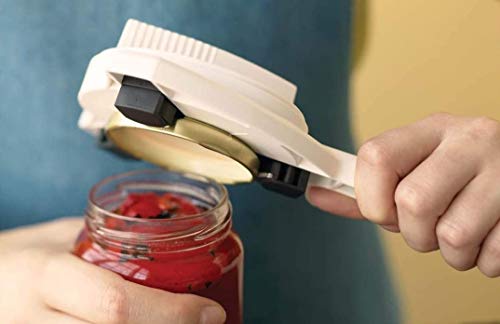
Next up we have the Kuhn Rikon Strain-Free Gripper Opener for Jars and Bottles and it’s a neat little tool, indeed. Measuring 10 x 5 x 2.25 inches, this tool features 3 sets of stainless steel ‘jaws’ that lock onto the lid when you simply twist the dial on top. Once in place, the long handle means that you’ve got excellent leverage to easily open 1 to 3.5 inch jar lids. Aside from the gripping portions of the jaws, the rest of the tool is made of a lightweight plastic and once you see how easy it makes opening your jars, we think you’re going to love it!
Pros:
This tool is very different from most openers and the design is definitely sound – This Gripper opener works exactly as advertised and that long handle makes it easy to pop those lids right off without much effort at all.
Cons:
Some folks may prefer a metal tool or an electric model to this plastic opener, but that’s a judgment call that you’ll have to make.

Some folks prefer a good, old-fashioned stainless steel tool and this Swing-A-Way Comfort grip is exactly that. Measuring 8.8 x 3.8, it won’t take up too much drawer space, and using it just requires adjusting it to the needed size, pulling the comfort grip to lock into place, and then giving the tool a turn.
Simple, effective, and exactly what you need to get a whole lot of leverage!
Pros:
The stainless-steel construction gives you a powerful and long-lasting tool that works quickly and efficiently.
Cons:
While this works as a nice tool to give you a little extra opening power, if you have severe carpal tunnel or arthritis then another model may be a little easier on your hands.
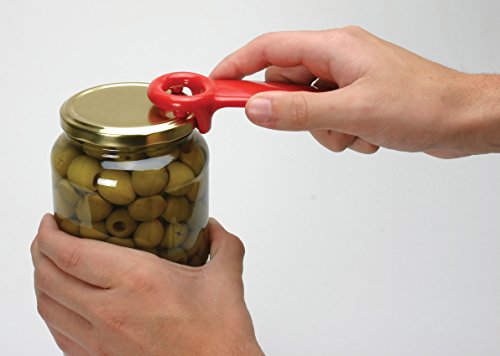
Next on our list is this Harold Import Company Brix Original Easy Jar Key Opener. Made in Denmark and endorsed as ‘Jar Key; and ‘Jar Pop’ by many arthritis associations around the world, this handy little 6 x 3 x 3 inch tool solves the toughest problem of opening jars – the air pressure. While some tools cover the whole lid, this tool is designed simply to sit on the edge of the lid and then to let you apply pressure to release that vacuum seal. Once the seal is breached, lids usually pop right off with very little application of force. For some folks, that’s just about all that you need!
Pros:
The air pressure from the vacuum seal really is the toughest part of getting a jar open, so this should be a perfect fit for some users with reduced hand strength or arthritis to contend with that just need a little helping hand.
Cons:
Not everyone likes the ‘key’ method and so some users may prefer a full-lid solution.

This jar opener is the Kitchwit All-Metal adjustable jar opener for arthritis and it’s a durable opener that you won’t be replacing anytime soon. The simple-but-effective design allows you to latch onto jar lids measuring between 3/8 and 4 inches wide, lock the tool in place, and then voila! You’ve got leverage for easy-opening without stressing your hands very much at all! As an added bonus, they throw in a lightweight aluminum keychain bottle opener that also comes in quite handy in a pinch. If you’re not that keen on plastic tools, then this stainless steel opener might be an excellent fit for you!
Pros:
Stainless steel tools are great. They’re long lasting and if they are designed well, they quickly become favorites and get a lot of use. The Kitchwit is designed well so it really fits the bill.
Cons:
For minor to moderate arthritis, this tool is a real godsend, but severe arthritis sufferers may prefer an electric solution or an under the counter opener where the jar may be held with both hands.

The ReneeChef Under The Counter Opener gives you a mountable opener where the mounting is optional. Measuring 8.3 x 5 x 1 inches, the opener is made of plastic, with a V-shape insert that features gripping stainless steel teeth. This allows you to open any sized jar by inserting it into the V, and simply giving it a twist. The ReneeChef may be installed under a cabinet or counter, or you can simply put it on top of the jar and give the handle a twist. If you like under the counter ‘steel teeth’ openers but you’re lukewarm about installing one, then the ReneeChef fits the bill to a ‘T’!
Pros:
Adding a handle to an under the counter opener to allow for ‘manual’ opening is a nice touch and this opener performs its job nicely.
Cons:
Not everyone will like that it’s mostly plastic, but that’s going to be down to personal preference – plastic is lightweight, after all, so some will view this as a plus.

Our final opener is the Oxo Good grips Jar Open with a Base Pad and it’s a handy and dapper black opener with rigid stainless steel teeth. Nothing fancy or complicated, to use this tool you can simply slide it over the top of any size of jar lid until you meet resistance and once it’s in place, give the lid a counter-clockwise twist. It even has an arrow pointing in the opening direction so that you can use the tool intuitively the first time and the handle is countered for superior grip. Not too shabby at all, we think!
Pros:
It’s a good-looking and useful tool – while a lot of openers are in bright colors, this is ‘black and steel’ and gives a nice aesthetic to the standard white ‘steel V’ style openers.
Cons:
‘Steel teeth’ design openers will tear a plastic lid, but for metal ones they are just about perfect.
FAQs
It’s just about time for our ‘official verdict’ of our favorite jar openers from today’s list but before we go there, we’ve compiled a few frequently asked questions and their answers that we hope you’ll find useful. Let’s take a look and then we’ll get to wrapping things up!
What is the best jar opener for arthritic hands?
That will depend on the severity of the arthritis. For some, a ‘jar key’ that locks on the vacuum-sealed lid to release the pressure may be all that they need, but for more severe cases of arthritis, an electric opener may be the best fit. An ‘under the counter’ option is also a nice solution as it allows for one or two-handed opening of a jar and it looks more like a ‘cool kitchen convenience’ than a tool to assist in someone with opening jars due to their arthritis(and this can help in getting them to use it if you think a standard tool might upset them!).
Are under the counter jar openers better than tools?
Whether or not they are better is a matter of personal opinion, but we can say that they are certainly quite convenient and effective. Under the counter models that are installed tend to be made to last and usage is very simple – put the jar under the counter into the opener and suddenly a light twist has a lot of power.
Another advantage is that you can’t lose an opener that’s installed in or under a cabinet, but tools get misplaced all of the time. Like anything, it will be a judgment call, and while we can’t say they’re better, we can say they’re pretty fantastic to have even if you don’t need the assistance!
Is a grip opener better than a jar key for opening jars?
It will ultimately depend on the sensitivity of the opener’s hands. For instance, with a jar key, you would use it by hooking the tool onto the lid and by pushing up, releasing air as the vacuum is compromised, but the jar is still closed after this and requires a twist to open. It will certainly be easier to open, but if someone has severe arthritis it might still be a little painful to do so.
With a handled grip opener, by contrast, you generally have a disc-shape opening that fits on top of the jar, and then you can turn a knob on top to lock it into place, and after that the long handle gives you a surprising amount of leverage, so that opening the lid is much, much easier, even with the vacuum seal.
So, for severe arthritis or carpal tunnel, a grip-style or even an electric opener will be best, while milder cases may simply warrant a jar key type opener.
The Verdict
Now that we’ve shared 10 of the best jar openers for seniors in your life, it’s time for us to talk about our Top 3 favorites so that you can learn a little more about them and what we liked. Let’s see if you agree with our choices!
Our overall opener – Moeuonb Stainless steel Jar opener
We liked that the Moeuonb was so ruggedly durable. With 100% stainless steel construction, it looks solid and it IS, and since you install it in a cabinet or under a counter, it doesn’t even take up any space that you weren’t already using.
By placing a jar lid into the V-shape of the Moeuonb, the steel teel can lock on the lid, and a simple one handed twist is all that you need to open the jar. You can use two hands if you like for added assurance that you won’t drop the contents when the lid quickly pops right open! It’s a long-lasting solution and nice to have in the home even if you don’t have arthritis or carpal tunnel.
Most durable tool- Kichwit All-metal Adjustable Jar Opener for Arthritis
The Kitchwit is a clever tool and since it’s stainless steel, it’s a tool that you won’t be replacing anytime soon. The tool is notched, so that by loosening the clamp handle you can select the size that you need quickly, clamp it onto the lid, and then you have instant leverage for opening the jar that you wouldn’t otherwise have. Best of all, it doesn’t look like a tool designed to be used because someone needs the assistance, but rather simply a more efficient way to open jars that everyone should have!
Best option for severe arthritis – Humutan Electric Jar Opener for Seniors with arthritis
Our final favorite was this Humutan Electric Jar Opener for Seniors with Arthritis and this handy electric gadget runs on a pair of AA batteries and does ALL of the opening work once you’ve placed it on a jar and pressed the button on top.
Once pressed, 3 grippers underneath lock into place on the jar and rotate the lid to open it right up! It’s a neat little gadget indeed and folks with severe arthritis will really love it!
We hope that you’ve enjoyed the list today and that one or two of these openers have caught your eye. If they weren’t one of our favorites, then no worries – all of the jar openers we’ve shared today are excellent options – so go with the one that you feel is the best!
Thanks so much for visiting and we hope to see you again soon!




David learned to cook at an early age after his mother told him that he couldn't live on pizza forever, Dave uses his modest kitchen skills to recreate sorely-missed recipes from home and to occasionally make new favorite ones from places he is visiting.