
With everyone having access to the internet these days, we have access to a whole lot of facts that were generally hard to find before. People are taking advantage of this and making excellent life decisions, right down to how the water they drink is filtered and this brings us to our subject for today.
In this article, we’re going to tell you about the best water filters that remove fluoride and chlorine from your drinking water so that you can enjoy clean and pure drinking water without the worry of the chemicals that might come with it.
Along the way we’ll talk about the merits of personal water filtration and answer a few popular questions along the way, so that by the time we’re done you’ll have some excellent new information and some fine options for implementing your own personal water filtration strategy for your health.
Let’s talk about the best water filters that remove fluoride and chlorine!
Our Top picks at a glance
Selecting the best fluoride water filters involves considering test results, flow rate, and compatibility with your kitchen sink to ensure pure water throughout your home in the United States.
For those of you in a rush, here’s your sneak peek at today’s favorites:
- Best Personal Pitcher – ZeroWater 20-Cup Ready-Pour 5-Stage Water Filter Pitcher – The ZeroWater 20-cup provides you with a perfectly-sized personal filtration option that can filter 99.6% of all dissolved solids, including fluoride, chlorine, and heavy metals. It also comes with a testing meter to check its work!
- Best Countertop solution – SimPure Y7P-BW UV Countertop Reverse Osmosis Water Filtration Purification System – The SimPure Y7P-BW takes filtration to the next level with a combination UV light and filter approach, removing 99.99% of contaminants such as chlorine, fluoride, bacteria, and even viruses from your drinking water and fits conveniently on the counter.
- Best Shower filter – AquaHomeGroup Shower Head Filter for Hard Water – This AquaHomeGroup Shower head filter with a 20-stage filtration process that gives you purified water which it has also fortified with vitamins A, C, and E for healthy hair and skin and it works with most shower heads at home.
- Most Efficient Under Sink option – Frizzlife RO Reverse Osmosis Water Filtration System – 600 GPD High Flow – The Frizzlife Reverse Osmosis Water Filtration system not only cleans your water of 99.99% of other 1000 contaminants, but also saves water with a 1.5:1 drain ration. When you add in that it can handle 600 GPD to make the hit to your water pressure a minimum, it was an easy win for the Most Efficient Under Sink option.
Why should I invest in a water filter? Are fluoride and chlorine really that bad?
Chlorine and fluoride have been part of our drinking water for a very long time now. While fluoride didn’t become a regular thing until 1945, when it was first added to the water supply in Grand Rapids, Michigan, Chlorine goes back much further to 1897 as a cleanliness measure following a typhoid outbreak in the U.K.
The argument behind fluoride was that it would help prevent tooth decay at the recommendation of the U.S. Surgeon General, and chlorine was adopted as a cheap way to kill bacteria in water to make it more potable.
Fast-forward to the modern day and we’ve learned a few things.
Excessive fluoride removal is something we need to consider now since excess fluoride in our water supplies can lead to dental health issues like fluorosis, highlighting the health risks associated with water fluoridation.
Chlorine, while good at killing germs, is still a bleach and in the wrong amounts, it can lead to heart problems, cell and tissue damage, and increased risk of asthma and colon cancer.
It’s in the tap water, so what can you do?
The answer is simple – filter your own water. Modern filtration methods can take that tap water and clean out not only the fluoride and chlorine, but other contaminants such as lead, nitrates, heavy metals, and new risks like fracking water that’s managed to seep into the water supply.
Filtration is accomplished in different ways, such as layered filter solutions and even Ultraviolet light, but the results can be pretty amazing – 99.99% filtered water, free of bacteria, contaminants, and even viruses if the filtration system is up to the job.
Reverse osmosis filters, carbon filters, and alumina filters are some additional types among the most effective ways to achieve fluoride-free water, meeting the ANSI standard for fluoride reduction.
Now that we know, courtesy of the wondrous internet, you’ve got a chance to make a proactive change in your health at the most basic level – you’re drinking water – and every day someone is doing exactly that.
If this is something that interests you then you’ve come to the right place.
In our next section, we’re going to introduce you to some of the best filtration options on the market today so that you can get started on improving the quality of your water at home and reaping the health benefits that come with it.
If you’re ready, then let’s get a look at those filters so that you can get an idea of what kind of options you have and how to get exactly the ones you want!
The Best Water Filters That Remove Fluoride and Chlorine
In the sections below we’ve collected a list of 10 filtration options covering a wide range of applications. We’ve got personal pitchers, countertop units, showerheads, and robust filtration units that you can install right underneath the sink.
For each one, we’ll give you the dimensions and tell you a little about what they bring to the table. We’ll also briefly touch on the pros and cons of each and before we go, we’ll tell you our favorites and you can see if you agree.
With that said, here are the best water filters that remove fluoride and chlorine!
Personal Pitchers
Sometimes you need a solution that will deliver clear, filtered water, but which isn’t going to take up a lot of space. These 2 personal pitchers are among the best on the market and we’ve chosen 10 and 20 cup volumes that should fit most ‘personal pitcher’ needs. Let’s take a look!
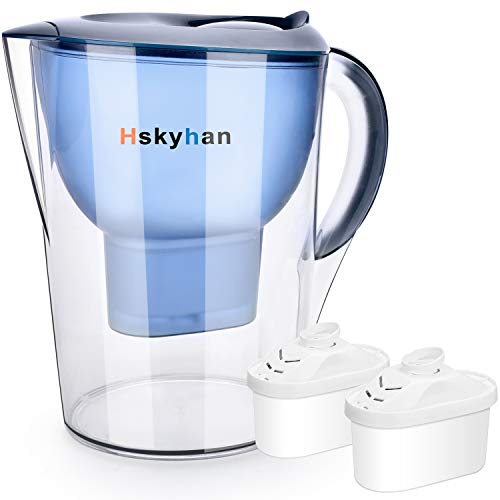
This Hskyhan Alkaline Water Filter Pitcher is a great option for one or two people who like their water clean and pure, just the way Nature intended. Measuring in at 10.2″L x 5.9″W x 9.8″H and weighing just 1 pound, it’s sweet and petite, but what does it bring to the table?
Through their 7-layer alkaline filtration, you can remove chlorine, fluoride, odors, and other contaminants, and save yourself a bundle on bottled water in the bargain. It will also raise the pH from .5 to 2 or more, making it alkaline. Best of all, if you somehow break it within 18 months, they’ll replace it for free!
This package comes with your water jug, 2 filters, and instructions so that you’ll be ready to go in no time. If you’re looking for a personal filtration pitcher for yourself and someone special, then this might just be a perfect fit!
Pros:
Easy to use, looks sharp, and the 18-month replacement guarantee makes for a pretty attractive package.
Cons:
The 10 cup capacity may not be sufficient for everyone and you’ll need to stock up on spare filters if you drink a lot of water.
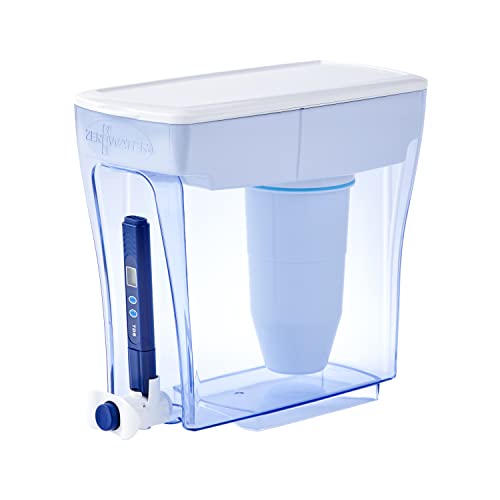
If you need a little more volume and more robust filtration, then feast your eyes on this ZeroWater 20-cup Ready-Pour 5-stage water filter pitcher. Measuring in at 10.63″L x 5.5″W x 11.75″H and weighing about 3 pounds, the ZeroWater gives you a 4.7 liter capacity ready and at your disposal.
The filtration is pretty solid, removing 99.6% of all dissolved solids, and it will also remove chlorine and get about 99% of the fluoride out of your drinking water.
It also reduces chromium and other heavy metals and comes with a handy TDS meter so that you can test the water and you’ll know when to change the filter. If the idea of a handy countertop or fridge water dispenser sounds like a treat, then the ZeroWater is gonna be a perfect match!
Pros:
Good capacity, excellent filtration, and the meter they throw in for testing is nice. It also doesn’t take up a lot of space and looks nice in the kitchen.
Cons:
As with any filtered option, you’ll need to stock up on extra filters if you and your family go through a lot of filtered water. That said, if you buy a lot of bottled water, then this will be a good alternative.
Countertop filtration units
For those who like the idea of a ‘portable oasis’, these countertop units will do the trick nicely. Capable of superb filtration and portable, you can have delicious, filtered water ready and waiting wherever you like! We’ve chosen 2 of the best and we’ll outline their features in the sections below.
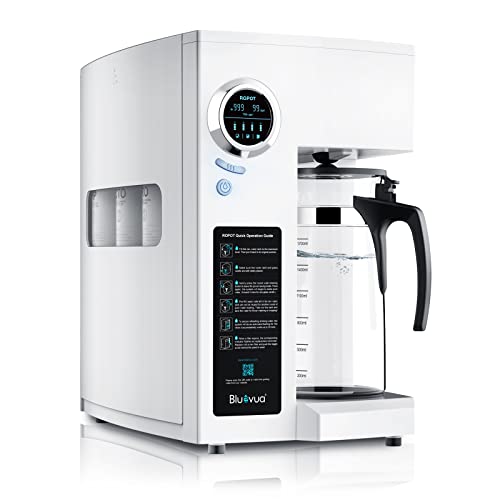
Our first countertop water filter is the Bluevua RO100ROPOT Reverse Osmosis system and it has a sleek coffee maker-type look to it complete with a borosilicate glass carafe to keep your purified water fresh. Measuring at 14.3″L x 10.9″W x 15.4″H and weighing 23.15 pounds, it’s certainly solid, but what can it do?
Well, with its 4-stage filtration, the Bluevua is capable of high-quality filtration, removing a whopping 99.9% of all possible contaminants. You won’t be constantly replacing filters all the time, either, as they last 12 – 24 months a pop.
When not in use, it will automatically enter a power save mode, and leftover water is not considered waste, but rather retained in the unit. When the time comes to change the filter, the monitor on the front will let you know, and it even comes with a 1-year warranty and tech support.
All in all, it’s a fine countertop filtration unit and we think you’re going to love it!
Pros:
This is a fine piece of technology that provides superior filtration and looks on the counter. The filter life is a huge perk as well.
Cons:
The glass carafe is part of the package because it won’t react with the water, but if you’ve got children then there’s always a chance of that carafe taking a fall. Also, this is not a direct-tap unit, so you’ll need to deal with keeping it full.
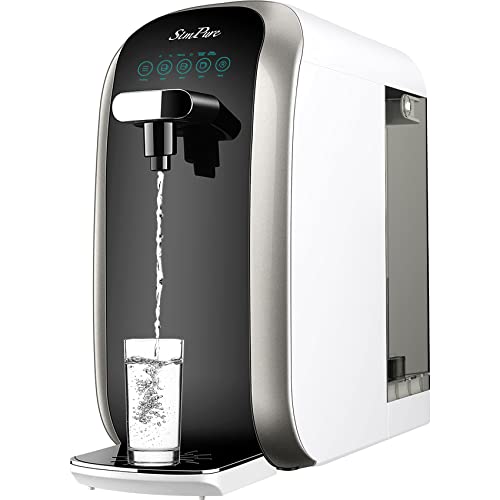
Our second countertop unit is this SimPure Y7P-BW UV Countertop Reverse Osmosis Filtration Purification system and it’s a real beauty! Measuring in at 18″D x 8″W x 17″H and weighing 18 pounds, it’s made of food-grade materials, and brings fine filtration and some handy features to the table.
Starting off, this countertop filtration unit is capable of removing 99.99% of over 1000 different contaminants, including fluoride, fluorine, chlorine, and even bacteria and certain viruses. This is done by a combination of a 3-stage filtration and ultraviolet light
It’s not a fast filtration the first time that you use it, but afterwards whenever the water lowers past a preset volume, the unit will start its slow and thorough filtration to fill the reservoirs back up to maximum capacity.
The display on the unit will tell you when it’s time to replace the filters and speaking of those, you get 2 of them with this unit, along with an instruction video and manual. It’s also capable of dispensing 418 gallons a day, so if you want superior filtration and high volume, the SimPure is worth a closer look!
Pros:
Sleek, powerful, and able to deliver the goods in high volume, this is an excellent countertop unit that you can get a lot of mileage out of.
Cons:
This is not a direct-tap unit, but rather one that you fill. This means you can use it anywhere in the house, but you will have to navigate lifting the full tank to put into the unit and that’s not going to work for everyone.
Shower heads
Filtering the water you drink won’t protect you 100% from exposure to chemicals in tap water that you’re probably better off without.
Incorporating whole house filters into your water filtration systems ensures that not only your drinking water but also your showering water is free from fluoride and chlorine, safeguarding your family’s oral health and skin health.
To accommodate this, we’ve found 2 of the best shower head options that can provide filtration so that when you go to clean yourself you aren’t exchanging dirt for chemicals. Take a peek and see what you think!
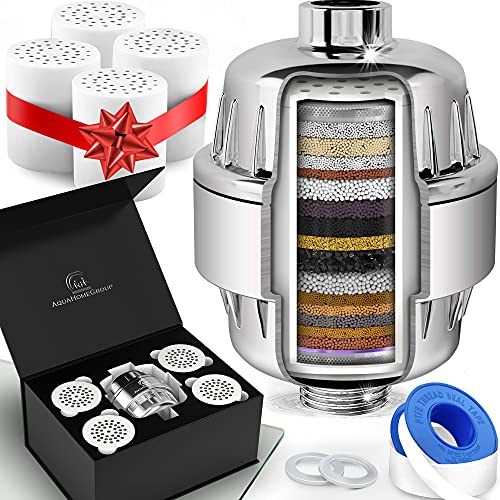
This AquaHomeGroup shower head filter is designed to make hard water soft and to provide superior filtration while it does it. Weighing just 3.65 pounds, the unit is designed to fit your existing shower head and will filter out things like rust, fluoride, chlorine, and more, with a powerful 20-stage filter.
Aside from filtration, the layers in this filter will help to add vitamins A, C, and E to the water, so that stronger nails, fuller hair, and healthy skin are promoted at the same time that you’re removing chemicals and odors from your water.
Aside from your standard filter, you’ll get 4 replacement filters, and they even throw in 5 shower caps and some Teflon Plumber’s tape you can use to fortify against leaks. It’s a nifty filtration system that solves that pesky problem of keeping chemicals out of your showers!
Pros:
The filtration layers are pretty intense and adding vitamins into the mix is a nice innovation that we’d have to say we like.
Cons:
Connections are a bit on the short side, so you may need an extender to use this. Other than that, it’s a stellar filter that replaces contaminants with vitamins and you really ‘can’t beat that with a stick’.

Next up we have this HarJue Filter High-Pressure shower head and it’s a showerhead/filter combo made of shiny stainless steel.
You heard us right – it’s made of 10 inches of 304 rustproof stainless steel, weighs 5.1 pounds, and comes with 3 types of mineral bead for different filtration perks – including lemon scented vitamin C!
If you’ve had trouble with filters sapping all of your water pressure, then the HarJue solves this nicely – even at a low setting, you’re getting a powerful jet of water, all while chlorine, fluoride, and heavy metals are being filtered and reduced to negligible levels.
The unit features 3 spray modes and comes with an extra filter, washers, 5 feet of hose, your shower head, filter, 3 way water diverter, plumbing tape, and an install wrench – everything you need to get your new favorite shower head installed and ready to go!
Pros:
It’s a neat showerhead that’s easy to install and with the Vitamin C, you’ll definitely feel the results after a wash or two.
Cons:
Not everyone wants to replace their entire shower head and for those folks, a filter-only solution will be a better fit.
Under Sink systems
While countertop units are nice, refilling a tank all of the time gets old and for some folks, is also not an option as it’s simply too labor intensive – those things are heavy, after all! For those who want a solution you can clamp on the tap, we present these undersink filter options that we think you’re going to love!

This Frizzlife Reverse Osmosis Water Filtration system is our first entry and it can filter a whopping 600 gallons per day! Measuring 15.3 x 15.7 x 9.5 inches and weighing 33 pounds, the tankless design will save you space under the sink while providing you with excellently filtered, clean water.
This unit is designed for remineralization and alkalization, so that your resulting water has a pH better than 7.5, all while being filtered from fluoride, chlorine, and 99% of over 1000 other contaminants.
Simply put, your water will get superbly filtered, remineralized, and then pH balanced with a quickness! A tutorial video is included and it takes about 30 minutes to install and it also teaches you how to test the water independently, but your SmartLED will also do that and tell you when the filter needs changing.
It also saves water with a 1.5:1 drain ratio. If you’re looking for some next-level filtration that makes a difference you can taste, the Frizzlife really fits the bill!
Pros:
You get 99.99% filtration in a sleek, space-saving package, with a Smart LED that you won’t need a degree to interpret. What’s not to like?
Cons:
Water flow will be a little slower but you won’t notice that getting a glass of water as much as you will when it’s time to do the dishes.

For those of you who liked the SimPure countertop unit but not the idea of swapping out the tank we present the SimPure Tankless UV Reverse Osmosis system. Measuring 16″L x 9″W x 18″H and weighing 17.6 pounds, this unit combines UV light and a static filtration system to clean out 99.99% of impurities.
Rated for 400 gallons per day, this unit also utilizes a 1.5:1 drain ration for saving water, and aside from chlorine and fluoride it can filter plastics, chemicals, heavy metals, bacteria, and even viruses! If you like the idea of a UV and filtration approach to clean water then this SimPure is well worth a closer look!
Pros:
The UV and filter strategy helps to get contaminants that simple filtration cannot and that’s the kind of functionality you really want in an undersink filtration unit.
Cons:
It DOES take up a bit of space under the sink and that’s going to be a dealbreaker for some folks.

Our next entry is this 100 GPD Express Water Reverse Osmosis Water Filter system and it’s both colorful and effective! Measuring 19 x 18 x 19 inches and weighing about 29.5 pounds, these units can filter up to 99.99% of heavy metals, fluoride, chlorine, arsenic, calcium, and more!
These cost-effective units have a cool perk, too – they’re upgradeable. Want to add UV filtration? You can do that. There are also fittings for deionization and other functions, so that you can completely customize a filtration solution just the way you want it.
Since it attaches to the tap, you won’t have to worry about filling unwieldy tanks, and on-demand support comes with each system so that your questions will be answered about how it works and what kind of upgrades you can add.
All in all, it’s a pretty neat system for those folks who want to have complete control of exactly what they’re filtering and the price definitely won’t break the bank.
Pros:
This really is a cool little system and we like that you can upgrade it – you aren’t stuck with a ‘one size fits all’ solution and if you wanted a complicated system but you’re on a budget, you can get excellent filtration now and slowly tweak it to your needs as your budget allows.
Cons:
The caveat of this unit is that at 100 GPD/gallons per day, your water pressure will be taking a hit, so filling up containers and doing the dishes is going to take longer. If that’s not a problem, you’ll love it, but the slower flow will definitely be unattractive to some users.

Our final unit is this APEC Water Systems Ultimate RO-PH90 which has a 90 GPD rating and is designed to clean 99% of impurities from your water. Measuring just 15 x 7 x 18 inches and weighing about 27.4 pounds, it’s Water Quality Associated tested and certified and engineered and assembled in the USA.
The APEC comes with 100% lead-free metal faucet and parts and also offers a 2 year extended warranty on registration and a lifetime of support. It’s a solid system, designed to last for decades, and capable of filtering fluoride, chlorine, heavy metals, and more than 1000+ other impurities from your water.
If you like an option that’s made a little closer to home and definitely delivers the goods, then we highly recommend taking a closer look at what the APEC has to offer!
Pros:
Designed, engineered, and assembled in the USA, this unit features excellent filtration and a robust design that you should get many years of happy use out of.
Cons:
At 90 gallons per day you’re going to have a lot less water pressure, so this is something you’ll need to factor in when you’re making your decision.
FAQs
It’s almost time for us to go, but before we check out today we wanted to address some frequently asked questions that we get a lot from readers. Let’s take a look and then we’ll tell you which filters were our favorites from today’s showcase and wrap things up!
Do water filters really remove chlorine?
Yes, water filters can effectively remove chlorine, although it depends on the filter that you are using. Reverse osmosis and activated carbon filters, for instance, are quite effective at removing chlorine, as they can absorb it and bind the molecules to the filter’s surface.
Does bottled water have fluoride?
It’s a common misconception that bottled water contains no fluoride, but that’s not always the case. It all depends on where the company is getting their water. Even with some natural sources like springs, if fluoride is already present in the water, then you’re going to get it in the bottle.
The only way to fully ensure that you aren’t ingesting fluoride is to actually filter the water yourself.
Does boiling tap water reduce fluoride?
No, boiling water will not get rid of the fluoride content, and as you lose some of the water to the boiling process you’ll be left with a smaller volume of water that has a higher fluoride ratio to what you had before.
Water will kill a lot of biological contaminants but for chemical ones, filtration is really going to be your best approach for processing your water into something clean and pure.
What is the best way to ensure fluoride reduction in my water supply?
The best way to ensure fluoride reduction is by using a combination of reverse osmosis filter, carbon filter, and specific fluoride filters designed to target sodium fluoride in water supplies, providing pure water that supports dental health without the health risks associated with excess fluoride.
The Verdict
It’s time to wrap things up and so we’re going to share with you our favorites from today and tell you a little more about what we liked about them. Keep in mind that these are just the ones that WE liked – all of the items showcased today are among the best on the market, so go with what fits YOU best.
With that said, below you’ll find out favorites!
Best Personal Pitcher – ZeroWater 20-Cup Ready-Pour 5-Stage Water Filter Pitcher
With a 20 cup capacity and a 5 stage filter, along with a meter to check that it’s working, it’s really hard not to like the ZeroWater 20-cup Filter pitcher.
As far as filtration, it filters 99.6% of TDS or ‘Total Dissolved Solids’, leaving you with crisp, clean water at a volume ample enough that refilling the unit won’t be a hassle. It’s pretty much everything you could want in a personal filter at a price that definitely won’t break the bank.
Best Countertop solution – SimPure Y7P-BW UV Countertop Reverse Osmosis Water Filtration Purification System
UV light AND a filter at work to clean our water? The SimPure does this, removing 99.99% of over 1000 impurities – fluoride and chlorine included – and with the UV light at play it’s also killing bacteria and viruses.
It also doesn’t hurt that it looks really sharp on the countertop, so it was a shoe-in for the win today!
Best Shower filter – AquaHomeGroup Shower Head Filter for Hard Water
This AquaHomeGroup shower head filter won for a few different reasons. First off, it’s very practical – it works with your home setup and you don’t have to replace your shower head. Next, it has 20 stages of filtration to filter out 99% on contaminants like fluoride and chlorine.
Finally, when the water’s purified, they’ve also imbued it with vitamins and you can feel the difference it makes after a few washings. Basically, it doesn’t just filter your water — it tailors it for good health –and we have to say that got our attention.
Most Efficient Under Sink option – Frizzlife RO Reverse Osmosis Water Filtration System – 600 GPD High Flow
Our final winner today was this Frizzlife Reverse Osmosis Water Filtration system which you can install under the sink and it will not only filter your water of 99.99% of over 1000 contaminants, but it will also re-mineralize and re-alkalize it. It’s not slow, either.
A lot of options on the market handle 90-100 gallons per day, but this lovely system can handle an impressive 600 gallons per day. It’s efficient, provides a wide range of treatments, and it’s FAST. What’s not to like?!
That’s all the time that we have for today but we hope that you’ve enjoyed this exploration of the best water filters that remove fluoride and chlorine. If you have any comments or want to share some filtering tips of your own, please leave them – we look forward to hearing them.
Until next time, we wish you and yours the very best!